Automation tailored to a process
A multi-agent build for the client’s specific process, without rewriting code for every task.
Agent orchestration · YAML → LangGraph
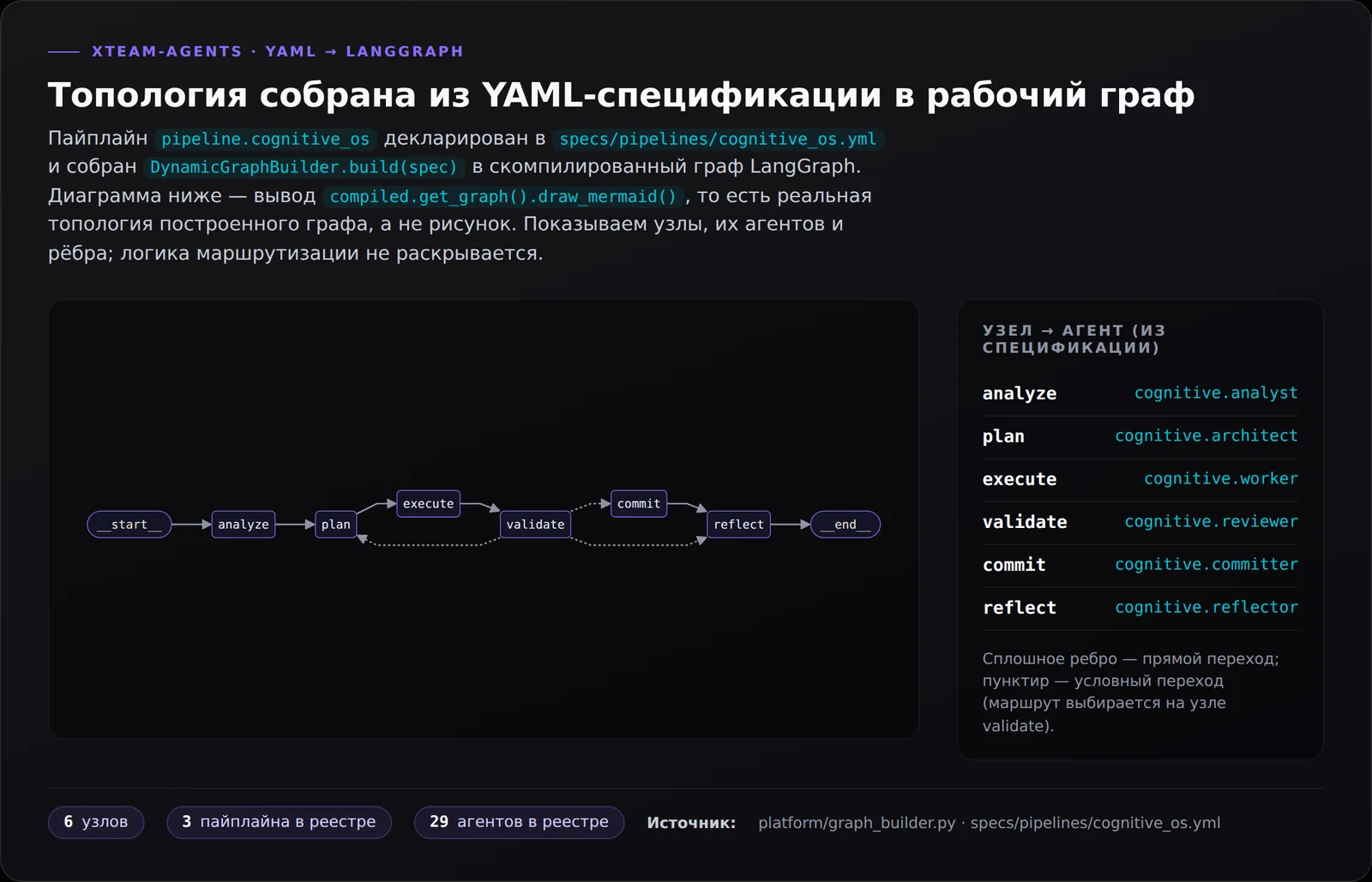
Assembling multi-agent automation from YAML specifications without rewriting code: the specification produces the graph and the agent topology.
Multi-agent automation for a specific process is expensive to build and change if every edit means rewriting code.
Hard-coded pipelines do not carry over to a new process without rework; the topology cannot be changed declaratively.
YAML specification → LangGraph graph → Mermaid topology; an agent registry queried by role and capability. We show the topology and the names; the routing heuristics are not disclosed.
A multi-agent build for the client’s specific process, without rewriting code for every task.
The agent topology changes by editing YAML, not code — the process carries over to a new environment declaratively.
A working graph is built from the specification and the topology is rendered; a registry of 29 agents queried by role and capability. We show the topology and the names.
Reproduce: graph_builder.build(spec) → Mermaid
A snapshot of a run at a pinned revision: 197 passed with the known non-green tests excluded — an honest boundary of maturity, not “everything is green”.
Reproduce: pytest
Agent topologies are described in YAML and assembled into a working graph for the client’s process.
AVA is a process-economics calculator. In a couple of minutes it shows whether this pays off in your case — before any call, with no commitment.
Estimate with AVATell us what needs solving. If it cannot be solved or will not pay off, we will say so up front, before any work starts.
or write to us directly: hello@xteam.pro