Auditable simulations
Reproducible, repeatable runs with a verifiable event hash — the result can be re-checked rather than taken on trust.
Agent runtime · MIT · reproducible
An open-source (MIT) runtime for self-organising agents: relationship negotiation, a resource economy, Byzantine agreement between nodes and recursive organisation into groups.
Multi-agent runs are hard to trust: they are hard to repeat and check. What is needed is reproducibility and auditability, not “take our word for it”.
Closed agent environments do not let you repeat a run and check the result; non-determinism turns a simulation into a one-off observation.
Unlike traditional orchestration, where agents are calls in a rigid pipeline, here agents are first-class entities: they negotiate, form groups and reach agreement on their own. The run is still deterministic: a replay reproduces the exact finalEventHash — trust through verifiability. Open source under MIT: you can download it and check for yourself.
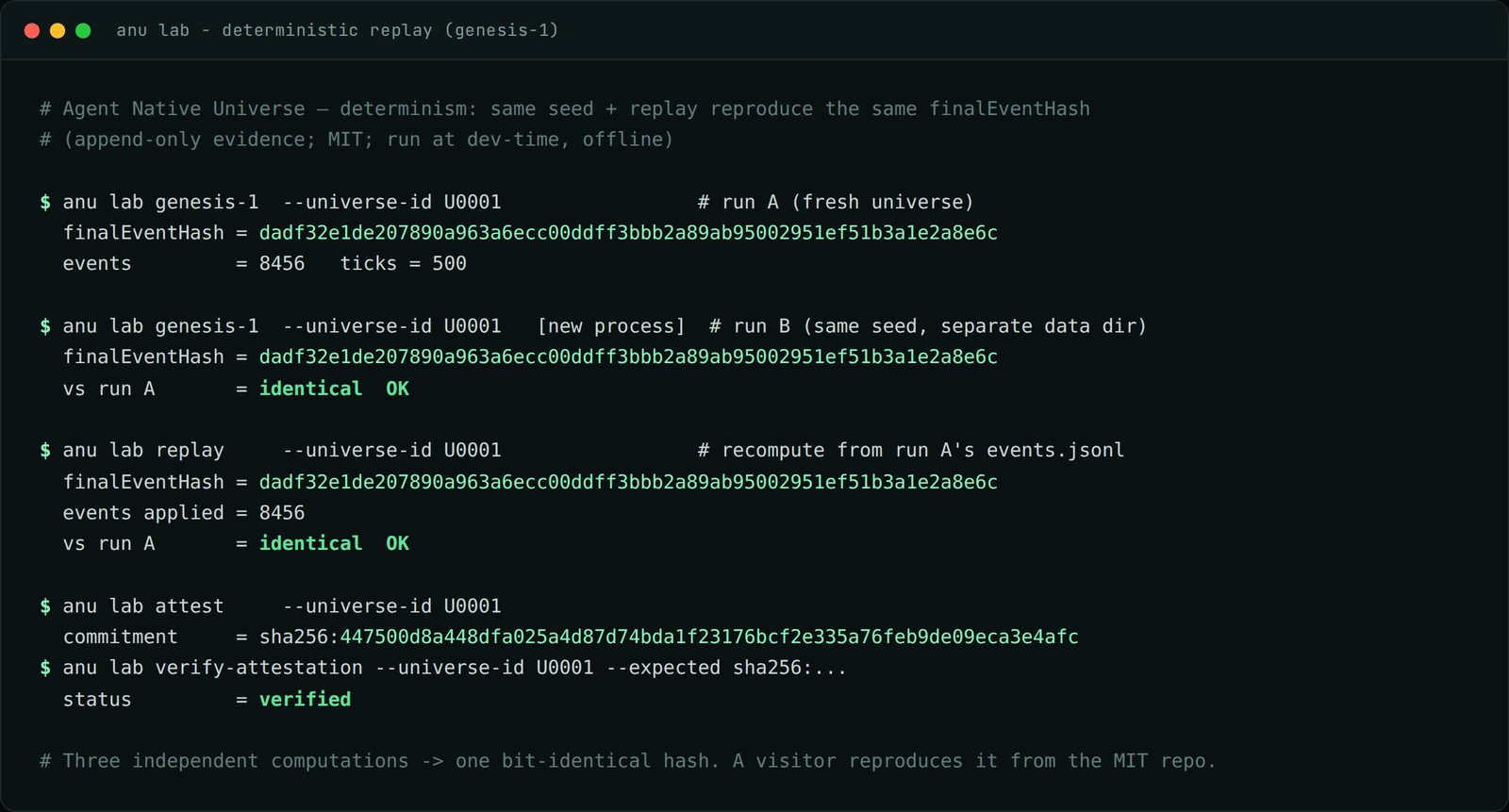
Reproducible, repeatable runs with a verifiable event hash — the result can be re-checked rather than taken on trust.
An MIT licence and an open repository: trust through being able to deploy it and check for yourself.
A repeat run gives a bit-for-bit identical final event hash — the run is verifiable, not a one-off observation. The strongest class of evidence: a visitor repeats it themselves. A real offline run: two independent runs on the same seed plus a replay from the append-only log converged on the same hash; attestation verified.
Reproduce: Clone the MIT repository → anu lab genesis-1 → anu lab replay → compare finalEventHash
0ccae60 · 2026-08-24
A read-only observer over append-only evidence: metrics, an emergence chart, a structural lens and integrity hashes. Captured on a local offline run; event payloads in the dashboard are already redacted by the observer itself (“inspect redacted payload”).
0ccae60 · 2026-08-24
A real run of the example: 3 NanoAgents with no orchestrator publish advertisements, find partners, negotiate links and adapt the protocol; they settle into one cluster, with no errors.
Reproduce: Clone the MIT repository → npm run demo:living → check the log (0 errors)
0ccae60 · 2026-08-24
An observation on a single seed, not controlled evidence: not a control-arm comparison, and the capacity target of 32×64×10000 was not reached. We give it as an observation, not as a result.
An open repository under MIT — you can deploy it and reproduce the runs yourself.
AVA is a process-economics calculator. In a couple of minutes it shows whether this pays off in your case — before any call, with no commitment.
Estimate with AVATell us what needs solving. If it cannot be solved or will not pay off, we will say so up front, before any work starts.
or write to us directly: hello@xteam.pro